
Checklist
Common padel grip mistakes
Direct answer
Most grip mistakes are not about strength or talent: they are small, repeatable habits that go unnoticed because they happen before the ball arrives. This checklist covers the most common ones, how to recognise them, and what to check on your own between sessions.
Marco LucasAURO
The hand drifts toward a frying-pan grip
The most common pattern: the hand slides toward a flatter position as a rally goes on, especially under pressure. Check by pausing between points and comparing your hand position to your starting reference.
Gripping too tightly
Excess tension reduces feel and racket control and tends to increase with fatigue. A simple check: if your forearm feels tired after a short rally, the grip pressure is probably higher than it needs to be.
A different starting point for each stroke
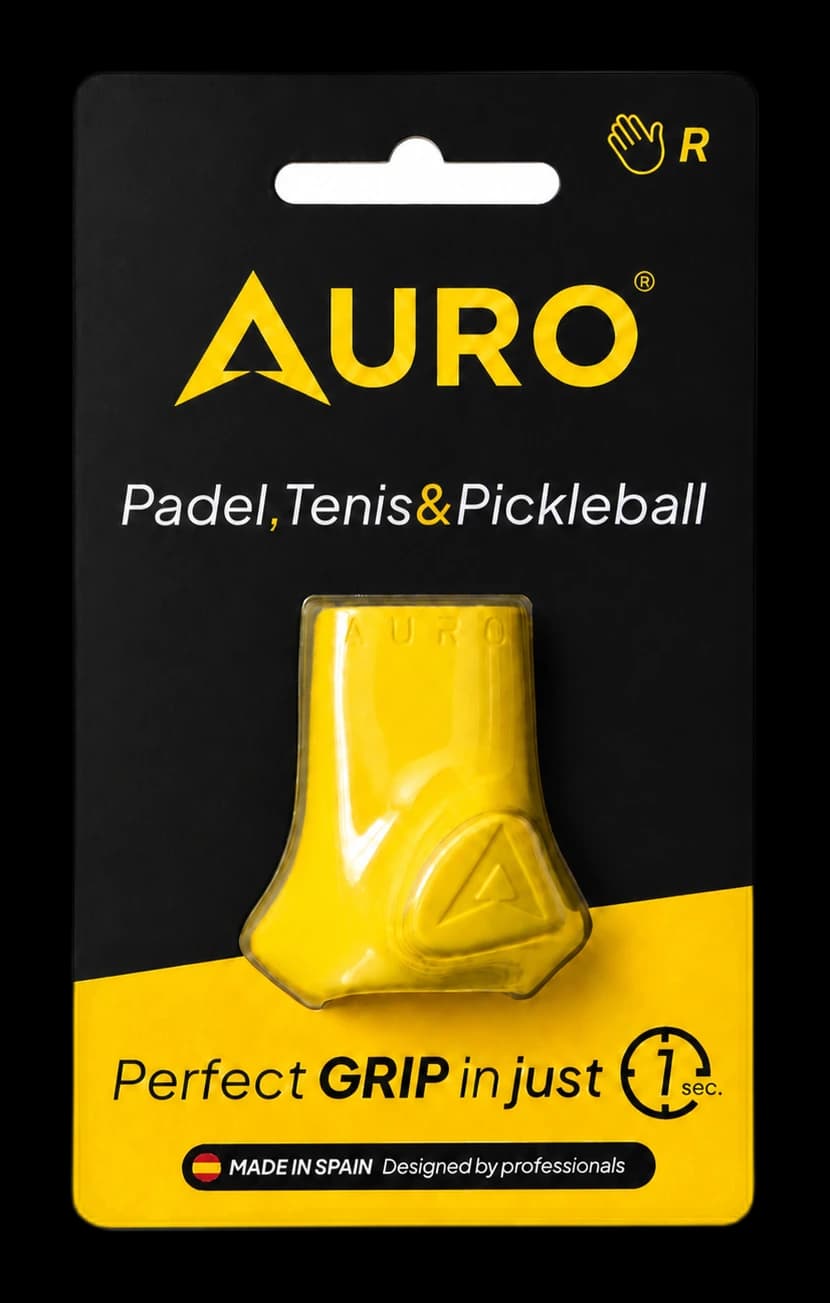
Auro Grip is a physical guide that helps your hand find the continental grip on a padel racket handle. If the forehand, backhand and volley each start from a slightly different hand position, every stroke needs its own correction instead of building from one base.
Correcting only during play, never before
Trying to fix the grip mid-rally rarely works — there is no time to think about it. Checking it between points, or before a session starts, is more effective than trying to correct it live.
What this checklist does not cover
It does not diagnose technique for specific shots or replace a coach's eye. It is a starting point for what to check yourself, not a complete technical review.
Changing too many things at once
A new racket, a different overgrip, an extra layer and a grip adjustment in the same week make it impossible to know what improved and what got worse. When something goes wrong after several simultaneous changes, the only way out is usually reverting entirely and starting again one at a time, which is exactly the time you thought you were saving.
Copying another player's setup
Seeing what a stronger player uses is tempting, but thickness and layers depend on hand size and personal preferences that do not transfer. General technical references are useful; someone else's exact handle configuration rarely produces the same sensation in your hand.
Only correcting when something goes wrong
Reviewing your hand solely after an error is common, and it ties correction to mistakes rather than making it routine. Checking position on points that go well too, or before starting a session, turns it into a stable habit rather than a one-off reaction that disappears as soon as match tension rises.
Ruling out technique before equipment
The reverse order is also a mistake: people rebuild an entire stroke when the problem was a worn overgrip or a layer added a month ago. Before touching technique it is worth ruling out the cheap and quick causes, because an altered physical reference changes the sensation without any technical decision being made.
Trusting the feeling without ever checking it
The sense that everything is fine is least reliable exactly when something has drifted gradually, because incremental change goes unnoticed. Occasionally checking something you believe is resolved is not distrust: it is the only way to catch slow deviations before they become a new habit.
Working on grip only during lessons
It is common to attend to hand position during a lesson and forget it entirely across the week's matches. The problem is that match hours far outnumber lesson hours, so the habit that consolidates is the match one. Carrying the check into matches, however briefly, matters more than the lesson itself.
AURO
Frequently asked questions
How do I know if my grip is drifting?
Compare your hand position between points to how it felt at the start of the session. A physical reference makes that comparison easier to notice.
Is gripping tightly always a mistake?
Not always, but sustained over-tightening reduces feel and tends to tire the forearm faster than necessary.
Can I fix these mistakes without a coach?
You can check for them yourself between sessions, though a coach can confirm what applies to your specific technique.
Is playing with two overgrips a mistake?
Not if both are fresh and the resulting thickness still lets you close your hand comfortably. The real mistake is stacking a new wrap over a used one, which leaves an uneven base beneath the contact surface.
Which of these mistakes is most frequent?
Hand drift during the point, by some distance, because it happens unnoticed and shows up exactly when demands rise. The others tend to be spotted sooner because their consequences are more visible.
Can I correct several of these at once?
Working through them one at a time is preferable. Tackling several simultaneously splits your attention and leaves you unable to tell which correction worked, which is precisely the information you need to keep progressing.
Do these mistakes disappear entirely over time?
They reduce considerably, but they are worth revisiting occasionally even when they seem resolved. Under pressure or fatigue old patterns commonly resurface, especially squeezing harder than necessary.