
Buying guide
How to choose a padel overgrip
Direct answer
Search for the best padel overgrip and every result gives you the same answer, usually because the page earns a commission on it. This one names no winner. It explains the three decisions that actually change what you hold — thickness, surface and format — gives you a way to test each on your own hand, and says plainly where our own overgrip is the wrong choice.
Marco LucasAURO
What actually varies between overgrips
Thickness and length are the two specifications that change how an overgrip feels and how far it goes. AURO Overgrip is 0.65 mm thick and 120 cm long, with double-sided tape for a stable wrap.
When it needs replacing
Replace it when tack or absorption drops, or when the surface goes smooth. Players on court several times a week tend to change it every two or three weeks, depending on sweat and conditions.
Matching the pack to how much you play
A pack of 3 is enough to try it or renew one racket. A pack of 12 covers a season of regular play. A 60-unit drum makes sense for clubs, academies or anyone replacing several rackets on a schedule.
It works with or without AURO Grip
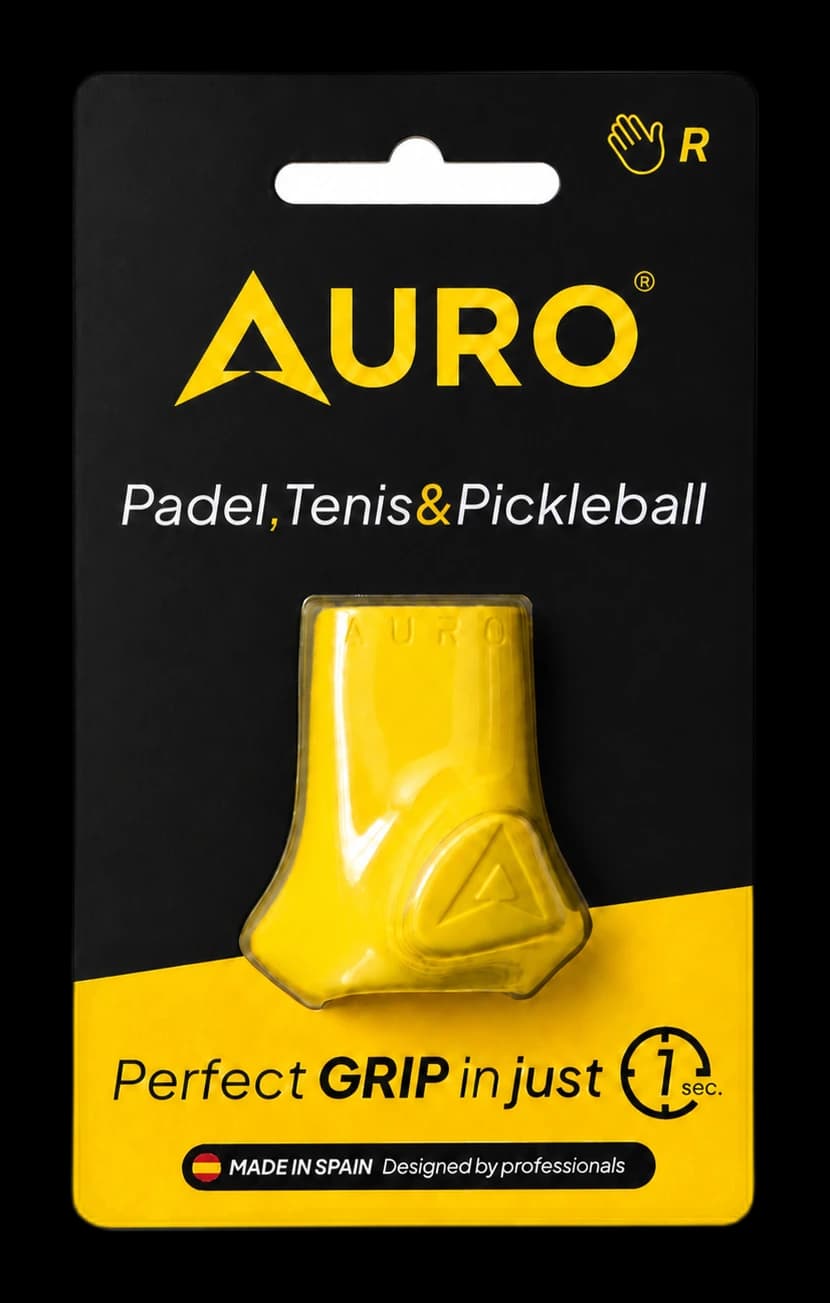
No. Auro Grip sits on top of the overgrip rather than replacing it: it guides hand position while the overgrip stays underneath for feel and sweat absorption. Choosing an overgrip pack is a separate decision from whether you also use a grip reference underneath.
Thickness: what choosing one over another implies
A thinner overgrip transmits more of the handle and alters the original thickness less; a thicker one adds volume and a little more cushioning. Neither is better in the abstract: it depends on hand size, how many layers you run and what feels comfortable. Changing thickness alters the reference of the whole racket, so try one at a time.
Smooth, perforated and textured
Smooth wraps offer a uniform surface; perforated ones carry holes that help moisture avoid settling on the contact face; textured ones provide a more pronounced feel. The choice usually comes down to personal preference and how much you sweat rather than any quality hierarchy between the three types.
Buying singles or a larger format
Occasional players can manage with single units. Anyone on court several times a week gets through a fair number each year, and the larger format avoids the most common scenario: stretching a worn wrap because there is no spare. The practical decision is less about price than about never running out of margin.
Try before committing to a box
Before buying a large format of a model you do not know, it makes sense to try a few units. Feel varies between brands more than the spec sheet suggests, and a box of an overgrip you dislike ends up at the back of a cupboard. Trying first costs little and avoids that outcome.
Start with what you already have
Before comparing models, check what you are currently playing with and whether it feels comfortable. Many people go looking for a better overgrip when they have actually had the same one fitted for months, and the problem was condition rather than choice. Ruling that out first avoids switching products for a reason that was not the product.
What you can know before trying it
The spec sheet tells you thickness, finish and whether it is perforated, and that already rules options out. What cannot be known without trying is feel, which varies between brands more than the numbers suggest. Hence the practical approach: shorten the list on paper and decide with your hand.
Change the model without changing everything else
If you are trying a different overgrip, keep the number of layers constant and do not debut it the same day you change anything else on the handle. That way whatever you notice is attributable to the new wrap rather than to a combination you will not be able to separate afterwards.
Why every guide gives the same answer
Search for the best padel overgrip and you will be told the same model on almost every page. That consistency looks like consensus and is mostly commerce: those pages are affiliate listings, and the model they crown is the one that pays. It may well be a good overgrip. What that verdict does not tell you is whether it suits your hand, and that is the only question the purchase actually turns on.
The index finger test, which decides thickness
Hold the racket as you would to play, then slide the index finger of your other hand into the gap between your fingertips and your palm. If there is no room, the handle is too thin for you and layers will help. If that finger cannot touch fingertips and palm at once, it is already too thick and another wrap makes it worse. It is the single most useful test in this whole subject and it takes five seconds.
The real range on the market, with numbers
Most padel overgrips sit between 0.50 and 0.60 mm, usually in steps you can feel but not measure by hand. Thinner transmits more of the handle underneath and changes the original thickness least; thicker adds volume and a little cushioning. Neither end is better — they trade feel against padding, and where you want to sit on that trade is personal.
Where our own overgrip sits, including the awkward part
AURO Overgrip is 0.65 mm, which is above that common range. That is deliberate and it is also a limitation worth stating: if what you want is the thinnest possible wrap and the most direct feel of the grip underneath, this is not that product. Saying so costs us some sales and saves the ones that would have come back.
Colour, and what it does not mean
Colour is aesthetic. The one practical consequence is that light shades show accumulated dirt sooner, which some players treat as a drawback and others as a feature: degradation you can see is degradation you replace on time. Claims that certain colours last longer circulate widely and are not something we can verify, so we do not repeat them.
How to store the ones you have not used
Somewhere dry and out of direct heat. A car boot through a summer is the worst place available: sustained heat degrades adhesive and surface before the wrap is ever opened. Buying a large format and storing it badly turns a saving into a waste, which is a mistake worth knowing about before it happens rather than after.
What should not influence the decision
The brand of your racket, which tells you nothing about who makes a good wrap. What a professional uses, since their replacement rhythm and sponsorship arrangements do not resemble yours. And the number of overgrips a page ranks, which measures the length of the article rather than the quality of the advice.
For clubs and academies
School rackets rotate between students, so the contact surface degrades faster than on a privately owned racket and the calculation is one of consumption rather than preference. Drums exist for exactly that case. The variable that matters most is not which model but how reliably you have one to hand when the surface goes, because that is what decides whether anyone actually changes it.
The mistake that makes the choice irrelevant
Choosing carefully and then leaving it on for a season undoes the decision entirely. A cheap wrap replaced on time outperforms an expensive one left until it shines, every time and by a wide margin. If you are going to optimise one thing here, optimise the replacement rhythm rather than the model.
AURO
Frequently asked questions
Is a thicker overgrip better for sweaty hands?
Not necessarily. Thickness changes how much handle you hold; what deals with moisture is the surface finish and how often you replace it. A tacky wrap left on too long performs worse than a dry one changed on time.
How thick should a padel overgrip be?
Most sit between 0.50 and 0.60 mm. Use the index finger test rather than the number: if that finger does not fit between your fingertips and your palm, the handle is already thick enough.
Can I put a new overgrip over an old one?
You can, and it is worth knowing what it does: it adds thickness, keeps whatever was degraded beneath it, and usually ends up thicker than intended. Removing the old one first gives a more predictable result.
Do padel and tennis overgrips differ?
The wrap itself is broadly the same product; what differs is the handle it goes on. A padel handle is shorter, so a 120 cm wrap covers it with less overlap than it would on a tennis racket.
Does overgrip colour affect performance?
No. The only practical difference is that pale colours show dirt sooner, which some players find useful as a visible signal that it is time to replace it.
How should I store spare overgrips?
Somewhere dry and away from direct heat. Sustained heat — a car boot in summer is the usual culprit — degrades the adhesive before the wrap is ever opened.
How long does one overgrip last?
It depends on how often you play and how much you sweat — commonly a few weeks for regular players, longer for occasional ones.
Which pack size should I buy?
A pack of 3 to try it, a pack of 12 for a season of regular play, or the 60-unit drum for clubs and academies replacing several rackets.
Does the overgrip go over AURO Grip?
No — it is the other way round. The overgrip wraps onto the handle first, and AURO Grip goes on top of it, on the outermost layer where the hand makes contact. The order is base grip, then overgrip, then AURO Grip.
How many overgrips does someone playing twice a week get through in a year?
It depends too much on sweat and climate to give a reliable figure. The practical way to estimate is counting how many you replaced across a representative month and multiplying, rather than starting from an average that may not resemble your case.
Do racket brands make the best overgrips?
There is no direct link between making good rackets and making good overgrips: they are different products. Trying a few models and keeping whichever feels comfortable is worth more than following your racket's brand.
Does colour affect anything?
Nothing beyond aesthetics and, at most, lighter shades showing accumulated dirt sooner. That last point can even be an advantage, since it makes visible a degradation that would otherwise go unnoticed.
Is it worth keeping two different types?
Some players alternate by season, using a perforated wrap in the hottest months and a smooth one the rest of the year. It is not essential, but it makes sense if you notice a large difference between summer and winter.