
Fundamentals
How to improve your padel hold
Direct answer
When someone says they want a better grip they may mean three problems that have nothing in common: the racket slipping, the handle not fitting their hand, or the hand not knowing where to sit. Each has a different fix, and confusing them means spending money in the wrong place.
Marco LucasAURO
Three different things under one name
Friction is how much the surface grips. Thickness is how much the handle fills your hand. Position is where the hand sits on that handle. All three are casually called grip, which is why conversations about it tend to run together.
Friction: the contact surface
This is what degrades with use and what is worth ruling out first. If the racket moves inside a hand that is correctly placed, the problem is almost always here, and it is solved by renewing the consumable rather than changing technique.
Thickness: how much the handle fills
The right thickness lets you close your hand comfortably without squeezing to keep the racket still. It is adjusted with the layers you add over the base grip. Changing it alters the feel of the whole racket, so add one layer at a time and give it a full session.
Position: where the hand sits
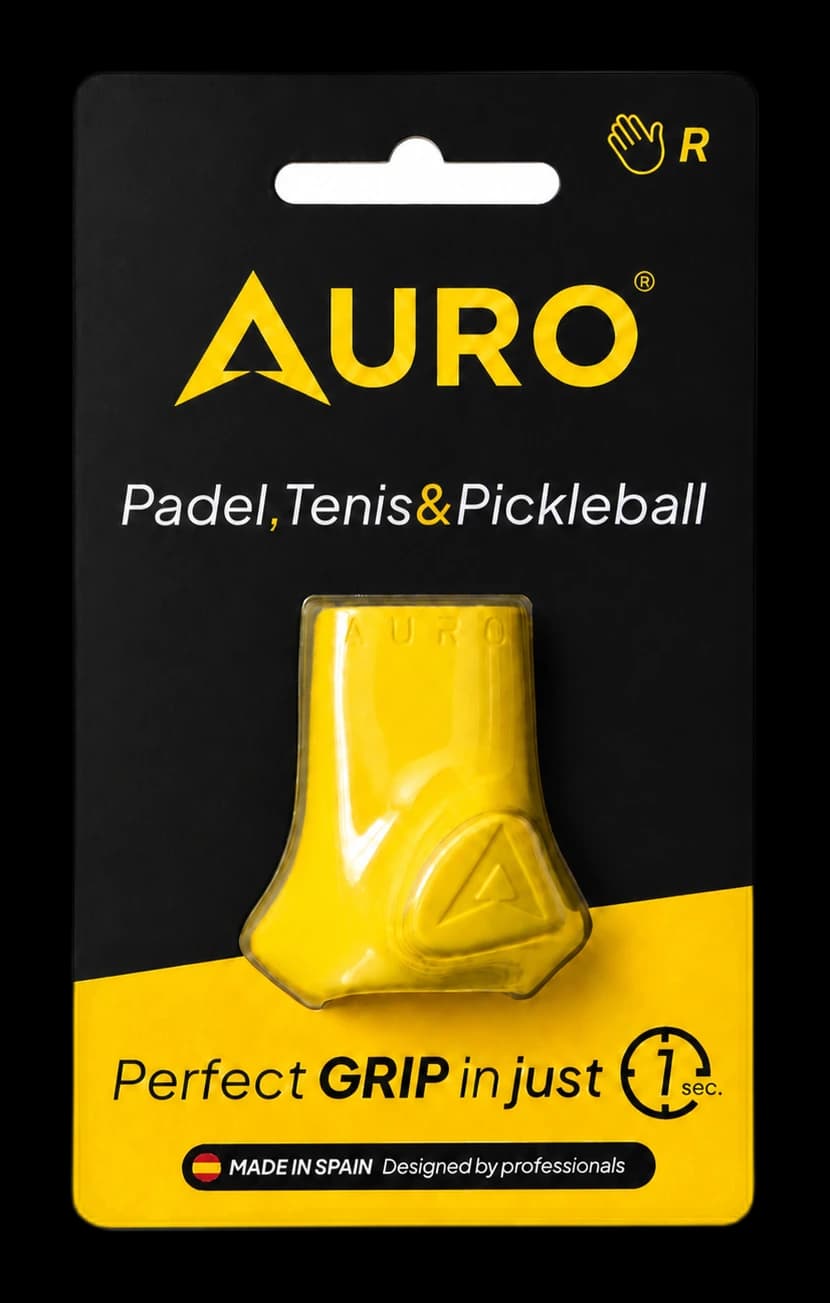
Auro Grip is a physical guide that helps your hand find the continental grip on a padel racket handle. This is the dimension consumables do not fix: it does not depend on how much the surface grips but on whether the hand returns to the same place shot after shot.
Pressure: how hard to squeeze
Squeezing harder than necessary reduces feel and tires the forearm early. It is usually a consequence rather than a cause: people squeeze when something does not inspire confidence, whether that is the surface, the thickness or the position. Fix those and pressure tends to drop on its own.
The order that saves money
Contact surface first, because it is the cheapest and degrades fastest. Thickness second, since it is adjusted without buying anything new. Position last, because it takes the longest: it is a habit rather than a piece of equipment.
What is not a grip problem
If the ball consistently goes off target but the racket does not move in your hand, grip is probably not the cause: that points to stroke technique or contact point. Diagnosing something else as a grip issue leads to replacing equipment that was fine while leaving the real fault untouched.
How to test a change without fooling yourself
Change one variable at a time and give it at least two full sessions. Trying a new overgrip, an extra layer and a different grip on the same day leaves you with no way to tell which of the three did anything. Compare under similar conditions too: a hot session and a winter one are not comparable.
The expensive mistakes
Buying a new racket over a grip sensation, stacking overgrips onto an already saturated base, and switching grip style mid-competitive-season. All three move many variables at once and leave you with no reference for what improved and what got worse.
A check you can do at home
Take the racket as if you were about to hit and close your eyes for a few seconds. Let go, drop your arm, and take hold again without looking. Repeat five or six times and see whether your hand lands in the same place or ends up slightly different each time. It needs no court and no ball, and in two minutes it tells you whether your starting point is stable or whether you are building every shot from a shifting base.
What to ask a coach
If you have access to a coach, the useful question is not whether your grip is correct but whether it is consistent between shots. The first depends on style and the specific stroke; the second is observable from outside, and it is where someone watching from the net sees things you cannot while playing. A session focused only on that often returns more than several on general technique.
When the right move is changing nothing
If the racket does not move, the handle feels comfortable and your hand returns to the same place on its own, there is nothing to optimise even if you see other players with different setups. Changing for its own sake has a real cost: for several weeks you play against a reference your hand does not recognise, and that gets worse before it gets better even when the change was a good one.
AURO
Frequently asked questions
Will a new racket improve my hold?
It is rarely the first thing worth changing. Handle shape varies little between models compared with what changes when you adjust layers and contact surface, and those are far cheaper to experiment with.
How do I know whether my problem is friction or position?
A useful clue: if the racket moves mainly once you have been playing a while and have sweated, that points to friction. If the sensation appears from the start or only on certain shots, it points to where you are placing your hand.
Is a thinner or thicker handle better?
It depends on hand size and personal preference; there is no correct value. The practical reference is being able to close your hand comfortably without squeezing to stop the racket moving.
How long before I notice a thickness change?
The first sessions usually feel odd even when the change is correct, because your hand had learned a different reference. Give it two or three full sessions before deciding whether the adjustment works or needs reverting.
Should I copy a professional player's grip setup?
General technical references are useful; specific thickness and layer counts are not. They depend on hand size and personal preference, so replicating someone else's configuration rarely produces the same feel.
Won't holding more lightly make the racket fly out?
It is the most common worry, and the practical answer is that security comes from friction and thickness rather than force. With those two properly resolved, you can hold with less pressure without losing control.
How often should I review all of this?
Contact surface continuously, because it degrades on its own. Thickness only when you change racket or feel discomfort. Position at any point where the sensation starts varying between shots.