
Padel grip guide
The continental grip in padel, explained through a physical reference
Direct answer
The continental grip is the hand position Auro Grip is designed to help you find on a padel racket handle, using a physical guide with separate right-hand and left-hand versions.
Marco LucasAURO
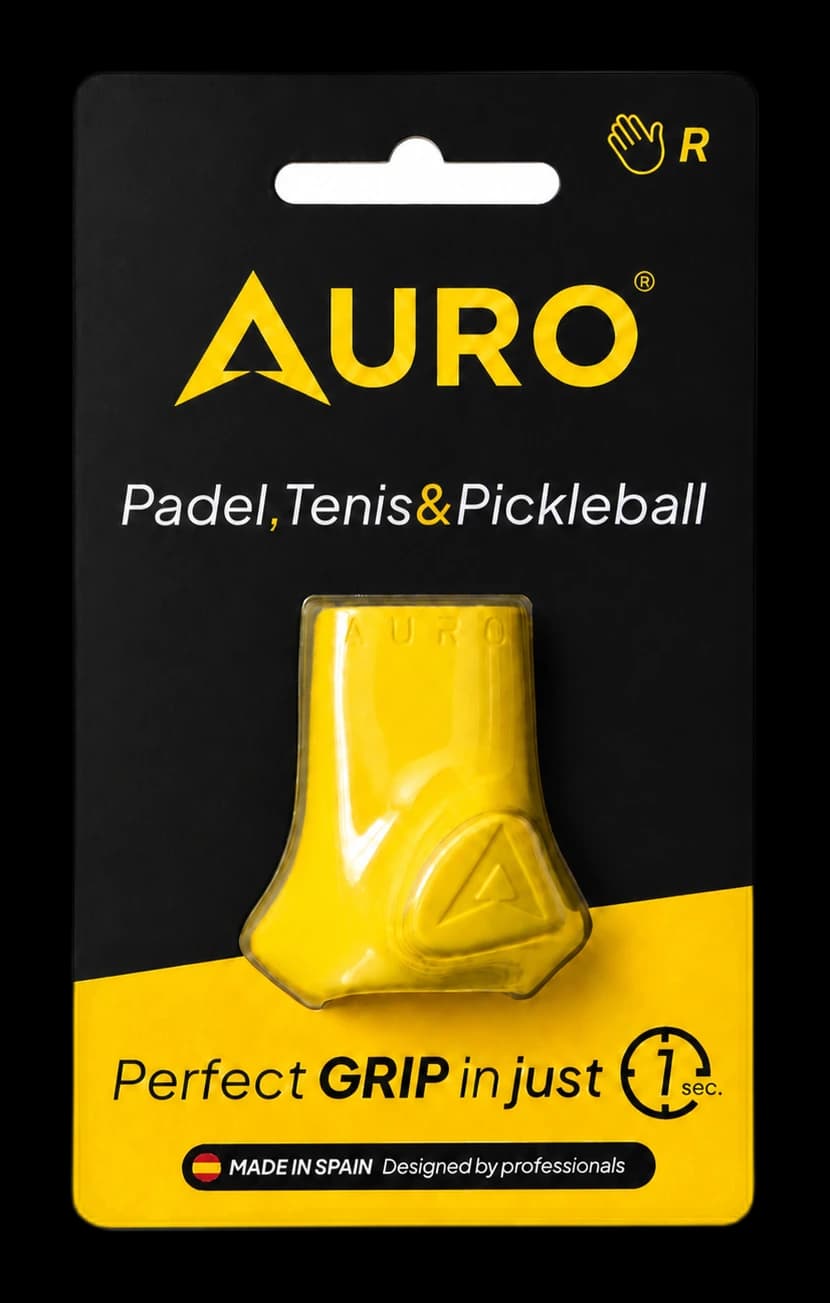
A reference your hand can feel
Auro Grip is a physical guide that helps the hand find the continental grip on a padel racket handle. Its role is to make the intended hand position tangible rather than replace the racket or the player’s overgrip.
Position 01: the starting reference
Position 01 has the more pronounced reference and is the one to start with when learning the continental grip.
Position 02: a reversible setup
Position 02 changes the setup without tools: remove Auro Grip, rotate it 180 degrees and reinsert it. This changes the orientation of the reference on the handle.
Handed versions and the overgrip
Right-hand and left-hand versions keep the guide ramp aligned with the player’s hand. Auro Grip does not replace an overgrip, which can still be used for feel and sweat absorption on the handle.
What the continental grip actually is
It is the way of holding the racket where the hand sits in an intermediate position, neither rotated upwards as for a flat forehand nor rotated downwards. It is often described as the hammer position, because the hand adopts an angle similar to holding one. Its defining characteristic is that the racket face ends up close to perpendicular to the ground without needing to turn the wrist.
Why padel leans on it so heavily
Padel strings together very different shots in very little time: a volley, a bandeja, a wall defence, a smash. Changing grip between each would demand time that does not exist at the net. The continental lets you meet most of those situations without resetting the hand, which is why it appears in practically any technical explanation of the sport.
Which shots keep it and where there are nuances
On forehand and backhand volleys, on the bandeja and on most wall exits it is the usual reference. On longer baseline strokes, some players rotate the hand slightly depending on the spin they want. It helps to understand the continental as a shared starting point rather than a rule forbidding any adjustment by shot and level.
Common stumbles while learning it
The most frequent is correcting the hand only when you remember to, usually after an error, and reverting to the comfortable position as soon as the point intensifies. The second is confusing grip with pressure: placing the hand correctly does not imply squeezing harder. The third is trying to change it mid-season, when the margin to absorb something new is smallest.
How long before it stops needing attention
It depends on how much you play and how deliberately you work on it, and no single timeframe applies to everyone. What is common is the middle phase: for a while the correct position feels strange and the old one feels natural, precisely because the old one is automated. That sensation does not indicate the change is wrong, only that it has not settled yet.
How it is usually explained on court
The image coaches repeat most is the hammer: holding the racket as if you were about to drive a nail with its edge. Another common reference is resting the racket on its edge across an open palm and closing the hand from there. Neither is more correct than the other; they are different routes to the same place, and each player finds one clearer.
Why it is hard to hold under pressure
In fast points the hand drifts towards whatever position feels most comfortable, usually the one it has used for years. It is not a lapse in concentration: an automated position demands fewer resources than one still being learned. That is why the drift appears exactly when the point gets demanding rather than during calm rallies.
How it relates to the rest of the body
The grip does not work in isolation: shoulder position, preparation and footwork determine whether you arrive at the shot in a state to use it. A correct grip with late preparation still ends up corrected by the wrist. It is better seen as one piece within the whole motion than as an independent adjustment.
AURO
Frequently asked questions
What does Auro Grip do for the continental grip?
Auro Grip is a physical guide that helps your hand find the continental grip on a padel racket handle. This is the product role used throughout this continental-grip guide.
Are the two positions only labels?
Position 01 has the more pronounced reference and is the one to start with. Position 02 is reached by rotating the piece 180 degrees, which changes the orientation of the reference. They are two real product configurations rather than editorial labels.
Can left-handed players use the same reference concept?
Yes. Auro Grip has right-hand and left-hand versions, so the ramp reference matches the player hand. Choose the version corresponding to the playing hand.
Is the continental grip mandatory in padel?
It is neither a rule nor a technical obligation, but the most widespread reference because it lets you meet very different shots without resetting the hand. Some players depart from it on specific strokes, particularly at the back of the court where more time is available.
Is it used for the serve as well?
It is the usual reference for the padel serve, as for most shots near the net. Since the serve is underarm and below waist height, the intermediate hand position fits the motion naturally.
Can I learn it without a coach?
The position itself can be understood and adopted on your own using references like the hammer. What is harder without help is spotting when it drifts during play, because that happens unnoticed while your attention is on the ball.
What if I have played for years with another grip?
Changing is possible, but expect the new position to feel worse than the old one for a while, precisely because the old one is automated. Choosing a stretch without important matches makes the process considerably easier.